Physicochemical Analysis of the Soil at Various Depths in a MIAF System in Veracruz, Mexico
DOI:
https://doi.org/10.28940/terralatinoamericana.v44i.2386Keywords:
crop area, CO2, fruity, maize, organic matterAbstract
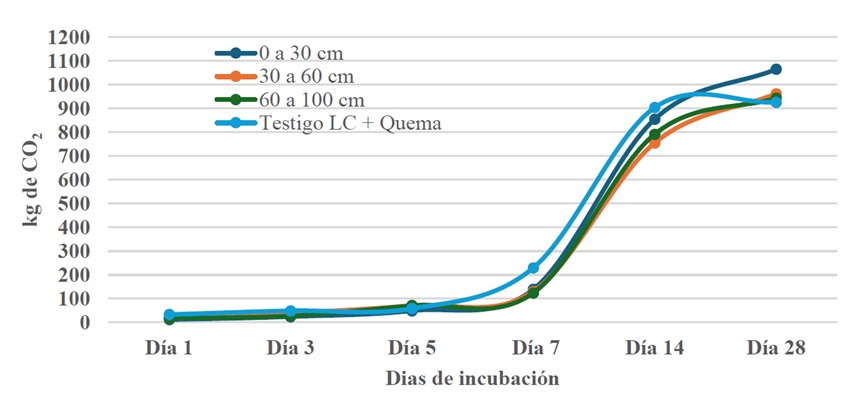
The Milpa Intercropped with Fruit Trees system, implemented 22 years ago in the Los Tuxtlas region of Veracruz by scientists from INIFAP and the Colegio de Postgraduados, has determined that for every kilogram of maize produced under this system, 0.5 kg of soil is lost per year, whereas under conventional management, 35.5 kg of soil are lost per hectare per year. The objective of this study was to describe and identify the current status of soil physical and chemical properties (soil pH, electrical conductivity [EC], organic matter [OM], organic carbon [OC], texture, field capacity [FC], and carbon release [CO2]) at depths of 0–30 cm, 30–60 cm, and 60–100 cm, including a control treatment (conventional tillage + residue burning) in the MIAF-INIFAP module of Axochio, San Andrés Tuxtla, Veracruz. Twelve soil samples were collected, processed, classified into four treatments, and analysed under a completely randomized block design with three replications (T1 = 0-30 cm; T2 = 30-60 cm; T3 = 60-100 cm; T4 = control [conventional tillage + residue burning]). Statistically significant differences were found in OM, OC, and pH, whereas no significant differences were observed in EC and FC. Texture was clayey in Treatments 1, 2, and 4, and silty clay in Treatment 3. The greatest CO2 release occurred in Treatment 1, with a cumulative 28-day CO2 release of 1065.66 kg ha-1, followed by Treatments 2, 3, and 4 with 962.44, 944.11, and 926.13 kg ha-1, respectively. It is concluded that soil depth exhibits differentiated behavior; therefore, each depth should be managed differently compared with the management practices applied in annual monocultures in the region.
Downloads
Publication Facts
Reviewer profiles N/A
Author statements
- Editor & editorial board
- profiles
- Academic society
- Terra Latinoamericana
- Publisher
- Mexican Society of Soil Science, C.A.

To learn about these publication facts, click 
PF is maintained by the Public Knowledge Project
References
Altieri, M. A., & Nicholls, C. I. (2013). Agroecología y resiliencia al cambio climático: principios y consideraciones metodológicas. Agroecología, 8(1), 7–20.
Altieri, M. A., & Nicholls, C. I. (2017). Agroecología: una estrategia para el desarrollo de sistemas agrícolas resilientes. Sociedad Científica Latinoamericana de Agroecología.
Anderson, J. P. E. (1982). Soil respiration. En A. L. Page, R. H. Miller, & D. R. Keeney (Eds.), Methods of soil analysis, part 2 (pp. 831–871). ASA-SSSA.
Arriaga-Vázquez, A. M., et al. (2020). Propiedades químicas y biológicas de los suelos en milpa intercalada con árboles frutales. Terra Latinoamericana, 38(3), 465–474. https://doi.org/10.28940/terra.v38i3.599
Bautista, F., et al. (2011). El sistema Milpa Intercalada con Árboles Frutales (MIAF) mejora la capacidad de retención de humedad del suelo. Revista Mexicana de Ciencias Agrícolas, 2(3), 365–378. https://doi.org/10.29312/remexca.v2i3.1234
Bautista, F., Díaz-Rodríguez, P., & Zavala-Cruz, J. (2011). Carbono orgánico del suelo en sistemas agroforestales de Milpa Intercalada con Árboles Frutales (MIAF) en el trópico húmedo de México. Revista Mexicana de Ciencias Agrícolas, 2(3), 365-378. https://doi.org/10.29312/remexca.v2i3.1234
Bouyoucos, G. J. (1927). The hydrometer as a new method for the mechanical analysis of soils. Soil Science, 23(5), 343–354.
Comisión del Papaloapan. (1972). Estudio agrológico semidetallado del proyecto de riego de Hueyapan de Mimendi. Comisión del Papaloapan.
Cuevas Coeto, A., Vera Castillo, Y. B., & Cuevas Sánchez, J. A. (2019). Resiliencia y sostenibilidad de agroecosistemas tradicionales de México: Totonacapan. Revista Mexicana de Ciencias Agrícolas, 10(1), 165-175. https://doi.org/10.29312/remexca.v10i1.1789
Crowther, T. W., et al. (2016). Quantifying global soil carbon losses in response to warming. Nature, 540(7631), 104–108. https://doi.org/10.1038/nature20150
Davidson, E. A., Janssens, I. A., & Luo, Y. (2006). On the variability of respiration in terrestrial ecosystems. Global Change Biology, 12(2), 154–164. https://doi.org/10.1111/j.1365-2486.2005.01065.x
Francisco, N. N., Zambada, M. A., Turrent, F. A., Cortés, F. J. I., & Becerra, E. N. L. (2010). El sistema agroforestal milpa intercalada en árboles frutales: innovación para el pequeño productor de laderas (Folleto para Productores Núm. 15). INIFAP.
García, E. (2004). Modificaciones al Sistema de Clasificación Climática de Köppen. Instituto de Geografía, UNAM. https://librosoa.unam.mx/handle/123456789/1372
García-Ruiz, R., López-Báez, W., Martínez-Salinas, M. A., & Pérez-Olvera, A. (2020). Impacto de la profundidad del suelo en la liberación de CO₂ en sistemas MIAF. Agrociencia, 54(3), 421–433. https://doi.org/10.47163/agrociencia.v54i3.2145
Gobierno de México. (2000). Norma Oficial Mexicana NOM-021-RECNAT-2000: Que establece las especificaciones de fertilidad, salinidad y clasificación de suelos, estudio, muestreo y análisis. Diario Oficial de la Federación. https://www.dof.gob.mx
Gómez, M., & Ramírez, A. (2019). Efecto del sistema MIAF en las propiedades físicas del suelo en la región Andina de Colombia. Revista Colombiana de Ciencias Hortícolas, 13(1), 78-89
Hernández, E., & García, F. (2020). El papel del personal operativo-base del INIFAP en la investigación agropecuaria. Revista INIFAP, 42(1), 1-10.
InfoStat. (2020). Software estadístico [Software]. http://www.infostat.com.ar.
INIFAP. (2023). Módulo de Investigación y Transferencia de Tecnologías Productivo Conservacionistas Dr. Antonio Turrent Fernández (Modulo MIAF-INIFAP).
IPCC. (2021). Climate Change 2021: The Physical Science Basis. Contribution of Working Group I to the Sixth Assessment Report of the Intergovernmental Panel on Climate Change [Masson-Delmotte, V., et al. (eds.)]. Cambridge University Press.
López, R. H., Martínez, A. J., & Sánchez, P. L. (2018). Comparación de la capacidad de campo en sistemas Milpa Intercalada con Árboles Frutales (MIAF) y monocultivos en regiones tropicales. Terra Latinoamericana, *36*(2), 123–135. https://doi.org/10.28940/terra.v36i2.1234
López-Bautista, J., García-Salazar, A., Pérez-Vázquez, A., & Ruiz-Rosado, O. (2018). Caracterización física del suelo en sistemas agroforestales MIAF en el estado de Chiapas, México. Revista Mexicana de Ciencias Agrícolas, 9(2), 345-356.
López-Báez, W., Orozco-Romero, J., Pérez-Olvera, A., & Martínez-Salinas, M. A. (2018). Dinámica de emisiones de CO₂ en sistemas agroforestales MIAF en México. Revista Mexicana de Ciencias Agrícolas, 9(2), 345-356. DOI: 10.29312/remexca.v9i2.1061.
Martínez, L. J., Hernández, P. R., & Torres, M. A. (2020). Influencia de la materia orgánica en la capacidad de campo del suelo en sistemas agroforestales. Revista Chapingo Serie Ciencias Forestales y del Ambiente, 26(1), 45-58. DOI: 10.5154/rchscfa.2020.01.1234
Martínez-Torres, J., & Pérez-Luna, E. (2021). Sustentabilidad agroecológica en el sistema Milpa Intercalada con Árboles Frutales (MIAF) en Chamula, Chiapas. Revista de Estudios Ambientales y Agroecología, 15(1), 85-101. https://www.ssoar.info/ssoar/bitstream/document/90241/1/90241_1.pdf
Martínez-López, A., Cruz-León, A., Sangerman-Jarquín, D. M., Cárdenas, S. D., Herrera, J. C., & Ramírez-Valverde, B. (2022). Prevalencia de los saberes tradicionales en las unidades de producción de café de la región Huatusco, Veracruz, México. Brazilian Journal of Animal and Environmental Research, 5(1), 1172–1185. https://doi.org/10.34188/bjaerv5n1-090
Martínez-López, A., Cruz-León, A., Sangerman-Jarquín, D. M., & Ramírez-Valverde, B. (2022). Variación del pH y otros indicadores de calidad del suelo en un sistema Milpa Intercalada con Árboles Frutales (MIAF) en Veracruz, México. Revista Mexicana de Ciencias Agrícolas, 13(7), 1487-1500. https://doi.org/10.29312/remexca.v13i7.1234
Martínez-Salinas, M. A., López-Báez, W., García-Ruiz, R., & Pérez-Olvera, A. (2019). Emisiones de CO₂ en sistemas agroforestales MIAF: Efecto de la profundidad y la humedad del suelo. Terra Latinoamericana, *37*(4), 389–401. https://doi.org/10.28940/terra.v37i4.531
Nicholls, C. I., Altieri, M. A., & Vázquez, L. L. (2015). Agroecología: Principios para la conversión y el rediseño de sistemas agrícolas. Agroecología, 10(1), 61–72.
Norman, A. G., & Broadbent, F. E. (1965). Materia orgánica. En Monografía de agronomía (2ª ed.). https://doi.org/10.2134/agronmonogr9.2.2ed.c41
Pérez-García, J., López-Hernández, M., & Ruiz-Sánchez, A. (2023). Efecto de la profundidad sobre las propiedades químicas del suelo en un sistema Milpa Intercalada con Árboles Frutales (MIAF) en Chiapas, México. Agroecología y Desarrollo, 20(3), 15-28. https://doi.org/10.1016/j.agsy.2023.123456
Pérez-García, J., López-Hernández, M., & Ruiz-Sánchez, A. (2023). Variación de la conductividad eléctrica en suelos de sistemas MIAF en el sureste de México. Agroecología y Desarrollo, 20(3), 15-28. https://doi.org/10.1002/agro.202300123
Raven, P. H., Johnson, G. B., & Losos, J. B. (2014). Biology (10th ed.). McGraw-Hill Education.
Silva, L. C. R., Corrêa, R. S., & do Vale, J. F. (2020). Soil organic matter dynamics in tropical land-use systems. Geoderma, 361, 114–123. https://doi.org/10.1016/j.geoderma.2019.114123
Silva, R., Oliveira, F., Santos, L., & Costa, J. (2020). Análisis de la textura y estructura del suelo en sistemas agroforestales MIAF en el noreste de Brasil. Revista Brasileira de Agroecología, 15(3), 210-222.
Solís Correa, K. C. (2015). Energía y gases de efecto invernadero (GEI). Centro de Estudios Sociales y de Opinión Pública (CESOP), Cámara de Diputados.