¿Por Qué un Suelo Arcilloso Tiene Baja Capacidad de Intercambio Catiónico? Composición Mineral y Elemental de Limos y Arcillas
DOI:
https://doi.org/10.28940/terralatinoamericana.v44i.2362Palabras clave:
minerales de baja actividad, óxidos metálicos, complejos organominerales, fertilidad edáfica, intemperismoResumen
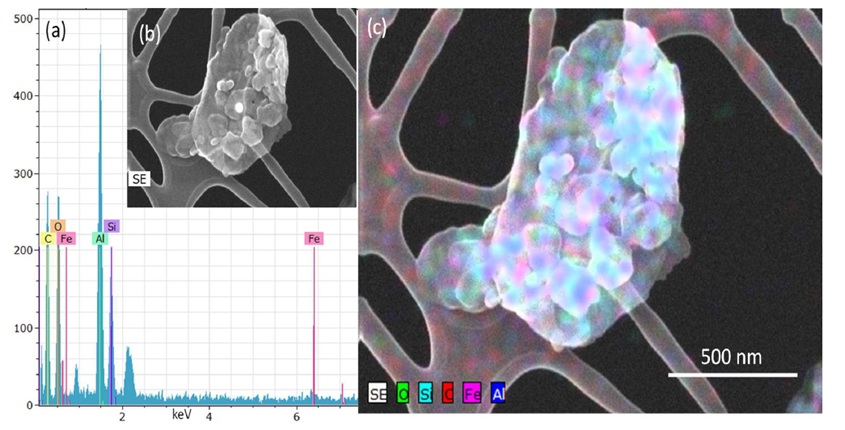
Los suelos ácidos del trópico mexicano, como los de Tabasco, se caracterizan por su textura fina, alto contenido de materia orgánica y, paradójicamente, baja capacidad de intercambio catiónico (CIC), lo que limita su fertilidad agrícola. Este estudio tuvo como objetivo identificar y caracterizar, por primera vez, la composición mineralógica y elemental de las fracciones de arena, limo y arcilla en un suelo fluvioaluvial ácido mediante técnicas de difracción de rayos X (DRX), espectroscopía infrarroja por transformada de Fourier (FT-IR), espectroscopía de energía dispersiva (EDS) y microscopía electrónica de barrido (SEM-STEM). Los resultados revelaron que la fracción arcillosa está compuesta principalmente por caolinita, con presencia secundaria de gibbsita, magnetita y sesquióxidos de hierro y aluminio, los cuales se adsorben a la superficie de la caolinita, reduciendo su CIC. La fracción limo presentó elementos como Al, Si, Fe y C, con bajos niveles de Ca y Mg, lo que indica una reserva nutrimental limitada. De forma novedosa, se detectó materia orgánica en fracciones de arena y limo formando complejos organominerales, posiblemente estabilizados por interacciones con óxidos metálicos, pH bajo y condiciones de anoxia estacional, derivadas de la alta precipitación anual (2,600 mm). Estos hallazgos sugieren que tanto la mineralogía dominante como las condiciones edafoclimáticas son responsables de la baja reactividad química del suelo. A pesar de estar clasificados como suelos agrícolas de clase III y IV, su uso está restringido a cultivos como cítricos, yuca, piña y plantaciones forestales. Esta investigación aporta evidencia original sobre la composición y funcionalidad de las fracciones finas en suelos ácidos tropicales y subraya la importancia de considerar no solo la textura, sino también la mineralogía y la geoquímica en el diseño de estrategias de manejo sostenible en regiones ambientalmente vulnerables.
Descargas
Publication Facts
Reviewer profiles N/D
Author statements
- Editor & editorial board
- profiles
- Academic society
- Terra Latinoamericana

Para obtener más información sobre un dato, haga clic

PF is maintained by the Public Knowledge Project
Citas
Aceves-Navarro, L. A., & Rivera-Hernández, B. (2019). Clima. En E. E. Mata-Zayas & D. J. Palma-López (Eds.), La biodiversidad en Tabasco. Estudio de estado: Vol. I (pp. 61–68). Comisión Nacional para el Conocimiento y Uso de la Biodiversidad (CONABIO) y Gobierno del Estado de Tabasco.
Adhikari, G., & Bhattacharyya, K. G. (2015). Correlation of soil organic carbon and nutrients (NPK) to soil mineralogy, texture, aggregation, and land use pattern. Environmental Monitoring and Assessment, 187, 735. https://doi.org/10.1007/s10661-015-4932-5
Agegnehu, G., Amede, T., Erkossa, T., Yirga, C., Henry, C., Tyler, R., & Sileshi, G. W. (2021). Extent and management of acid soils for sustainable crop production system in the tropical agroecosystems: A review. Acta Agriculturae Scandinavica, Section B — Soil & Plant Science, 71(9), 852–869.
Anderson J.M. and J. S. Ingram. (1993). Tropical soil biology and fertility. A handbook of methods, CAB International. Wallingford, United Kingdom.
Bautista, F., & Durán-de-Bazúa, C. (1998). Análisis del beneficio y riesgo potenciales de la aplicación al suelo de vinazas crudas y tratadas biológicamente. Revista Internacional de Contaminación Ambiental, 14(1), 14–19.
Bautista, F., Durán-de-Bazúa, C., & Lozano, R. (2000). Cambios químicos en el suelo por aplicación de materia orgánica soluble tipo vinazas. Revista Internacional de Contaminación Ambiental, 16(3), 89–101Bremner, J. M., & Genrich, D. A. (1990). Characterisation of the sand, silt, and clay fractions of some Mollisols. In Soil colloids and their associations in aggregates (pp. 423-438). Boston, MA: Springer US.
Bremner, J. M., & Genrich, D. A. (1990). Characterisation of the sand, silt, and clay fractions of some Mollisols. En M. E. Sumner & C. B. Stewart (Eds.), Soil colloids and their associations in aggregates (pp. 423–438). Springer.
Delmelle, P., Opfergelt, S., Cornelis, J. T., & Ping, C. L. (2015). Volcanic soils. En H. Sigurdsson (Ed.), The encyclopedia of volcanoes (2nd ed., pp. 1253–1264). Academic Press.
Djeran-Maigre, I., Razakamanantsoa, A., Levacher, D., Hussain, M., & Delfosse, E. (2023). A relevant characterization of Usumacinta river sediments for a reuse in earthen construction and agriculture. Journal of South American Earth Sciences, 125, 104317. https://doi.org/10.1016/j.jsames.2023.104317
Farro, N. W., Reyes, W., Mendoza, J. L., Veleva, L., Quintana, P., Azamar, J. A., & Aguilar, D. (2023). Characterization by XRD and FTIR of Zeolite A and Zeolite X obtained from fly ash. Chemical Engineering Transactions, 99, 679–684.
Feng, M., Kou, Z., Tang, C., Shi, Z., Tong, Y., & Zhang, K. (2023). Recent progress in synthesis of zeolite from natural clay. Applied Clay Science, 243, 107087. https://doi.org/10.1016/j.clay.2023.107087
Djeran-Maigre, I., Razakamanantsoa, A., Levacher, D., Hussain, M., & Delfosse, E. (2023). A relevant characterization of Usumacinta river sediments for a reuse in earthen construction and agriculture. Journal of South American Earth Sciences, 125, 104317. https://doi.org/10.1016/j.jsames.2023.104317
Geissen, V., Sánchez-Hernández, R., Kampichler, C., Ramos-Reyes, R., Sepulveda-Lozada, A., Ochoa-Goana, S., de Jong, B. H. J., Huerta-Lwanga, E., & Hernández-Daumas, S. (2009). Effects of land-use change on some properties of tropical soils—An example from Southeast Mexico. Geoderma, 151(1-2), 87–97. https://doi.org/10.1016/j.geoderma.2009.03.011
Graham, E. R. (1943). Soil development and plant nutrition: II. Mineralogical and chemical composition of sand and silt separates in relation to the growth and chemical composition of soybeans. Soil Science, 55(3), 265–277.
Hassink, J. (1997). The capacity of soils to preserve organic C and N by their association with clay and silt particles. Plant and Soil, 191(1), 77–87.
Hidalgo, C., Etchevers, J. D., Martínez-Richa, A., Yee-Madeira, H., Calderon, H. A., Vera-Graziano, R., & Matus, F. (2010). Mineralogical characterization of the fine fraction (<2 µm) of degraded volcanic soils and tepetates in Mexico. Applied Clay Science, 49(4), 348–358. https://doi.org/10.1016/j.clay.2010.06.008
Iniesta-Martínez, L., García-Ruiz, R., Sánchez, R., Goguitchaichvili, A., & Bautista, F. (2023). El magnetismo y el color como indicadores de cambios en el suelo por quema agrícola. Boletín de la Sociedad Geológica Mexicana, 75(2), 1-19. https://doi.org/10.18268/BSGM2023v75n2a050523
IUSS Working Group WRB. (2022). World Reference Base for Soil Resources. International soil classification system for naming soils and creating legends for soil maps (4th ed.). International Union of Soil Sciences (IUSS).
Lean, E. O. (1982). Soil pH and lime requirement. In A. L. Page (Ed.), Methods of soil analysis—Part 2—Chemical and microbiological properties (pp. 199–224). American Society of Agronomy.
Liu, J., Wang, Z., Hu, F., Xu, C., Ma, R., & Zhao, S. (2020). Soil organic matter and silt contents determine soil particle surface electrochemical properties across a long-term natural restoration grassland. Catena, 190, 104526. https://doi.org/10.1016/j.catena.2020.104526
López-Castañeda, A., Zavala-Cruz, J., Palma-López, D. J., Rincón-Ramírez, J. A., & Bautista, F. (2022). Digital mapping of soil profile properties for precision agriculture in developing countries. Agronomy, 12(2), 353. https://doi.org/10.3390/agronomy12020353
López-Reyes, L. Y., Domínguez-Domínguez, M., Martínez-Zurimendi, P., Zavala-Cruz, J., Gómez-Guerrero, A., & Posada-Cruz, S. (2016). Carbono almacenado en la biomasa aérea de plantaciones de hule (Hevea brasiliensis Müell. Arg.) de diferentes edades. Madera y bosques, 22(3), 49–60.
Maher, B. A., & Taylor, R. M. (1988). Formation of ultrafine-grained magnetite in soils. Nature, 336(6197), 368–370.
Mora, J. L., Guerra, J. A., Armas-Herrera, C. M., Arbelo, C. D., & Rodríguez-Rodríguez, A. (2014). Storage and depth distribution of organic carbon in volcanic soils as affected by environmental and pedological factors. Catena, 123, 163–175. https://doi.org/10.1016/j.catena.2014.07.014
Nelson, D. W., & Sommers, L. E. (1982). Total carbon, organic carbon, and organic matter. In A. L. Page (Ed.), Methods of soil analysis—Part 2—Chemical and microbiological properties (pp. 535–577). American Society of Agronomy.
Nie, Q., Li, Y., Wang, G., & Bai, B. (2020). Physicochemical and microstructural properties of red muds under acidic and alkaline conditions. Applied Sciences, 10(9), 2993. https://doi.org/10.3390/app10092993
Okalebo, J. R., Gathua, K. W., & Woomer, P. L. (1993). Laboratory methods of soil and plant analysis: A working manual. Tropical Soil Biology and Fertility Programme.
Palma-López, D.J., Cisneros, D.J., Moreno, C. E., & Rincón-Ramírez, J. A. (2007). Suelos de Tabasco: su uso y manejo sustentable. Colegio de Postgraduados-ISPROTAB-FUPROTAB. Villahermosa, Tabasco, México.
Palma-López, D. J., Moreno, C. E., Rincón-Ramírez, J. A., & Shirma, T. E. (2008). Degradación y conservación de los suelos del estado de Tabasco. Colegio de Postgraduados. Cárdenas, Tabasco, México
Palma-López, D. J., Jiménez-Ramírez, R., Zavala-Cruz, J., Bautista-Zuñiga, F., Gavi-Reyes, F., & Palma-Cancino, D. Y. (2017). Actualización de la clasificación de suelos de Tabasco, México. Agroproductividad, 10(12), 29–35.
Prado, B., Duwig, C., Hidalgo, C., Gómez, D., Yee, H., Prat, C., Estevez, M., & Etchevers, J. D. (2007). Characterization, functioning and classification of two volcanic soil profiles under different land uses in Central Mexico. Geoderma, 139(3-4), 300–313. https://doi.org/10.1016/j.geoderma.2007.02.006
Preetz, H., Igel, J., Hannam, J. A., & Stadler, S. (2017). Relationship between magnetic properties and reddening of tropical soils as indicators of weathering. Geoderma, 303, 143–149. https://doi.org/10.1016/j.geoderma.2017.05.022
Salgado-García, S., Palma-López, D. J., Zavala-Cruz, J., Ortiz-García, C. F., Lagunes-Espinoza, L. C., Ortiz-Ceballos, A. I., & Salgado-Velázquez, S. (2017). Los suelos ácidos de la sabana de Huimanguillo, Tabasco, México. Agro Productividad, 10(12), 16–21.
Sanchez, P. A., & Logan, T. J. (1992). Myths and science about the chemistry and fertility of soils in the Tropics. In R. Lal & P. A. Sanchez (Eds.), Myths and science of soils of the Tropics (pp. 35–46). Soil Science Society of America.
Soares, M. R., Alleoni, L. R., Vidal-Torrado, P., & Cooper, M. (2005). Mineralogy and ion exchange properties of the particle size fractions of some Brazilian soils in tropical humid areas. Geoderma, 125(3-4), 355–367. https://doi.org/10.1016/j.geoderma.2004.09.003
Tardy, Y., & Roquin, C. (1992). Geochemistry and evolution of lateritic landscapes. In I. P. Martini & W. Chesworth (Eds.), Weathering, soils and paleosols (pp. 407–443). Elsevier.
Thaymuang, W., Kheoruenromne, I., Suddhipraharn, A., & Sparks, D. L. (2013). The role of mineralogy in organic matter stabilization in tropical soils. Soil Science, 178(6), 308–315.
Tinal-Ortiz, S., López, D. J. P., Zavala-Cruz, J., Salgado-García, S., Palma-Cancino, D. J., & Hidalgo-Moreno, C. I. (2020). Degradación química en Acrisoles bajo diferentes usos y pendientes en la sabana de Huimanguillo, Tabasco, México. Agro Productividad, 13(2).
USDA. (1996). Soil survey laboratory methods manual (Version 3.0). United States Department of Agriculture, Natural Resources Conservation Service, National Soil Survey Center.
von Uexküll, H. R., & Mutert, E. (1995). Global extent, development and economic impact of acid soils. Plant and Soil, 171(1), 1–15. https://doi.org/10.1007/BF00009558
Villanueva-Partida, C., Casanova-Lugo, F., Villanueva-López, G., González-Valdivia, N., Oros-Ortega, I., & Díaz-Echeverría, V. (2016). Influence of the density of scattered trees in pastures on the structure and species composition of tree and grass cover in southern Tabasco, Mexico. Agriculture, Ecosystems & Environment, 232, 1–8. https://doi.org/10.1016/j.agee.2016.07.020
Zavala-Cruz, J., Salgado-García, S., Marín-Aguilar, A., Castelán-Estrada, M., & Ramos, R. R. (2014). Transecto de suelos en terrazas con plantaciones de cítricos en Tabasco. Ecosistemas y Recursos Agropecuarios, 1(1), 123–137.
Zavala-Cruz, J., Jiménez-Ramírez, R., Palma-López, D. J., Bautista-Zuñiga, F., & Gavi-Reyes, F. (2016). Paisajes geomorfológicos: base para el levantamiento de suelos en Tabasco, México. Ecosistemas y Recursos Agropecuarios, 3(8), 161–171.
Zhu, Y., Guo, B., Liu, C., Lin, Y., Fu, Q., Li, N., & Li, H. (2021). Soil fertility, enzyme activity, and microbial community structure diversity among different soil textures under different land use types in coastal saline soil. Journal of Soils and Sediments, 21, 2240–2252. https://doi.org/10.1007/s11368-021-02916-z